 SKIP TO
CONTENT
SKIP TO
CONTENT

What is a Statement of Net Worth and Why is it Required in a New York Divorce?
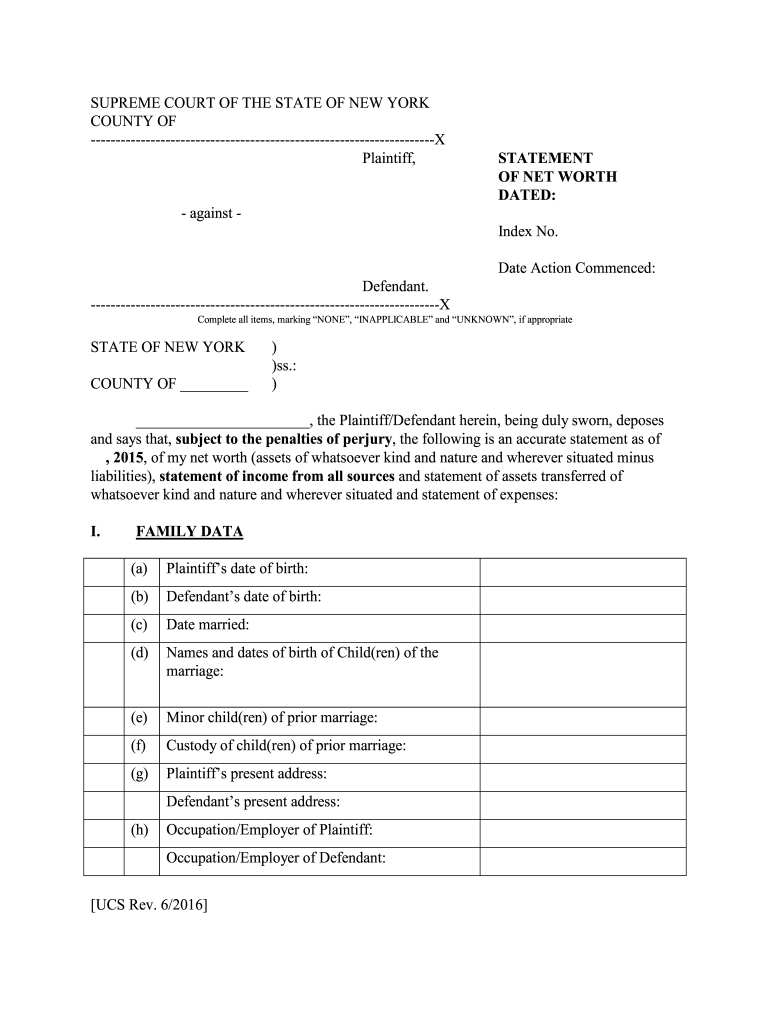
Table of Contents
Anyone going through a divorce in New York will generally be required to fill out a document called a Statement of Net Worth. It is one of the most important pieces of paperwork in any matrimonial case, and it is not optional. Whether the divorce is contested or uncontested, and whether the case is filed in Suffolk County Supreme Court or anywhere else in New York State, financial disclosure through the Statement of Net Worth is required by law.
What Is a Statement of Net Worth?
A Statement of Net Worth is a sworn financial disclosure document that both spouses must complete and exchange in any New York divorce involving maintenance (alimony), child support, or equitable distribution of marital property. The requirement comes from New York Domestic Relations Law Section 236(B)(4) and is enforced through the Uniform Rules for Matrimonial Actions found at 22 NYCRR 202.16.
The form itself is lengthy and it requires each party to lay out a complete financial picture under oath. If a party is represented by an attorney, the attorney must also certify the document.
Think of it as a financial snapshot. The court and the opposing side use it to determine how property should be divided, whether spousal support should be awarded, and how much child support is appropriate.
What Information Does the Statement of Net Worth Require?
The Statement of Net Worth is broken into several major sections. Each one asks for detailed information about a different area of a party’s financial life.
Family Data. This section covers basic personal and household information: names, dates of birth, Social Security numbers, employment details, the date of the marriage, the date of separation, and information about the children.
Income. Every source of income must be disclosed. That includes W-2 wages, self-employment earnings, bonuses, commissions, rental income, investment income, Social Security benefits, disability payments, and any other source of money coming in. The filing party will also need to attach the most recent pay stubs and the last three years of federal and state tax returns, including all W-2s, 1099s, and K-1 forms.
Expenses. This section asks for a detailed breakdown of monthly living costs. Housing, utilities, food, clothing, transportation, medical expenses, insurance premiums, childcare, education, and recreation are all included. The court uses this to assess reasonable needs and the standard of living during the marriage.
Assets. Each party must list every asset owned or held an interest in, whether solely or jointly. Bank accounts, investment accounts, retirement accounts, pensions, real estate, vehicles, business interests, life insurance policies, and personal property of significant value all need to be disclosed. For each asset, the party will typically need to provide the current value, the account number, and the institution where it is held.
Liabilities. This section requires a listing of all debts: mortgages, car loans, student loans, credit card balances, personal loans, and any other obligations.
Assets Transferred. Each party must disclose any assets transferred, sold, or given away within the past three years (or since the date of the marriage, whichever period is shorter). This is designed to identify whether either spouse has moved money or property around in anticipation of the divorce.
Support Requests. If a party is seeking maintenance or child support, this section is where the amount requested and the basis for that request are stated.
Attorney and Expert Fees. This section asks for disclosure of what has been paid to the attorney and any experts (such as appraisers or forensic accountants) and what is still owed.

Louis L. Sternberg, Esq.
Principal

Sara Carissimi, Esq.
Partner

Deborah Maniscalco
Paralegal

Nicole Berkman, Esq.
Of counsel

Ashley Pollak, Esq.
Of Counsel
When Does the Statement of Net Worth Need to Be Filed?
Under New York’s Uniform Rules for Matrimonial Actions, both sides must exchange their Statements of Net Worth no later than ten days before the Preliminary Conference. The Preliminary Conference is typically scheduled within 45 days after the case is assigned to a judge.
If either party makes a written demand for the Statement of Net Worth outside of that timeline, the other side has 20 days to respond. If no demand is made, the statements must be exchanged within 10 days after joinder of issue (meaning after the answer is filed).
In practice, a party will usually need to have the Statement of Net Worth substantially complete within the first few weeks of the case. Delays can create problems. Courts in Suffolk County and throughout New York take financial disclosure deadlines seriously, and falling behind can put a litigant at a disadvantage.
Take the First Step.
We Are Here to Help.
Schedule a free, confidential consultation with an experienced Suffolk County divorce and family law attorney. We will honestly explain where you stand and what your options are.
Why Is the Statement of Net Worth So Important?
The Statement of Net Worth is not just a formality or a box to check. It directly affects the outcome of a divorce in several ways.
It shapes equitable distribution. New York is an equitable distribution state, which means that marital property is divided fairly, though not necessarily equally. The court cannot divide assets or debts without first knowing what exists. The Statement of Net Worth is the foundation of that process. If a party fails to disclose an account or undervalues a piece of property, the court may not have the full picture, and that can affect how the final distribution is structured.
It affects maintenance and support decisions. The amount of spousal maintenance and child support paid or received is driven by both parties’ income and expenses. The Statement of Net Worth is where those numbers come from. Inaccurate income figures or inflated expense claims can distort the outcome of these calculations.
It is a sworn document. Because each party signs the Statement of Net Worth under oath, everything in it carries the same weight as testimony given in a courtroom. If the opposing side, or the court, later discovers that a party misstated income, failed to list a bank account, or inflated monthly expenses, there can be serious consequences.
It sets the tone of the case. Attorneys and judges look at the Statements of Net Worth early in the litigation to get a sense of the full financial picture. A well-prepared, thorough, and honest Statement of Net Worth tells the court and opposing counsel that a litigant is taking the process seriously. A sloppy or incomplete one can undermine credibility before a party ever sets foot in a courtroom.
New York Child Support & Maintenance Calculator
Try our complimentary interactive support calculator for maintenance and child support, with a printable worksheet.
What Happens If a Party Is Not Accurate or Does Not Comply?
Because the Statement of Net Worth is a sworn document, inaccuracies are taken seriously. The consequences can range from procedural penalties to criminal charges.
On the civil side, under CPLR Section 3126, a court can impose sanctions for failure to comply with disclosure obligations. These sanctions can include striking pleadings, precluding a party from introducing certain evidence, drawing adverse inferences on disputed facts, or even entering a default judgment. The court can also award attorney fees to the other party if a failure to disclose forces them to bring a motion to compel.
On the criminal side, because the form is signed under oath, a materially false statement can give rise to a perjury charge under the New York Penal Law. While criminal prosecution for misstatements in a Statement of Net Worth is rare, the possibility exists, and it should be taken seriously.
Even short of those extreme outcomes, an inaccurate Statement of Net Worth can erode a party’s credibility with the judge. Once a court doubts a litigant’s honesty about finances, every other claim made in the case becomes harder to prove.
Tips for Filling Out the Statement of Net Worth
Preparing a Statement of Net Worth takes time and effort. Here are some practical steps to keep in mind.
Gather records early. Tax returns, pay stubs, bank statements, investment account statements, mortgage documents, credit card statements, and loan records should all be pulled together before sitting down to fill out the form. Having everything in hand makes the process faster and more accurate.
Be thorough. It is better to disclose too much than too little. If there is any question about whether something needs to be listed, err on the side of including it. Omitting an asset or a debt, even by accident, can create problems later in the case.
Be accurate with expenses. Many people either underestimate or exaggerate their monthly expenses. Taking the time to review actual bank and credit card statements and calculate realistic figures is well worth the effort. Round numbers and guesswork can be challenged by the other side.
Update the form when things change. A party’s financial situation may shift during the course of the divorce. A raise, a job loss, new debt, or the sale of an asset may require an updated Statement of Net Worth. An attorney can advise on when an update is necessary.
Work with an attorney. The Statement of Net Worth is a legal document with real consequences. An experienced matrimonial attorney can help a litigant understand what the court is looking for, identify issues that might have been missed, and make sure the form is completed correctly.
Is a Statement of Net Worth Required in an Uncontested Divorce?
Yes. Even in an uncontested divorce, where both parties agree on all terms, the court still requires financial disclosure, except in those instances where both parties waive Statements of Net Worth. The judge needs to be satisfied that the agreement the parties reached is fair, and the Statement of Net Worth is how the court evaluates the financial circumstances of both sides.
In uncontested cases, the form may be somewhat simpler to complete because the parties are cooperating. But the same accuracy and thoroughness requirements apply.
Does the Statement of Net Worth Apply in Family Court?
The Statement of Net Worth is primarily associated with Supreme Court divorce proceedings. In Family Court, financial disclosure takes a slightly different form, but the underlying principle is the same: the court needs to understand each party’s financial situation to make decisions about support.
In Family Court proceedings involving child support or spousal support, parties are typically required to file a Financial Disclosure Affidavit, which serves a similar purpose. If a litigant has both a Supreme Court divorce case and related Family Court matters, an attorney can help coordinate the financial disclosure across both courts.
Frequently Asked Questions
How long does it take to fill out a Statement of Net Worth?
It depends on the complexity of the finances involved. For someone with straightforward income, a home, and a few accounts, it might take several hours to gather documents and fill out the form. For someone with multiple properties, business interests, or retirement accounts, such as those going through a high net worth divorce, it can take considerably longer. Working with an attorney can make the process more efficient and help avoid mistakes.
Can the other spouse see a party’s Statement of Net Worth?
Yes. The purpose of the Statement of Net Worth is mutual disclosure. Both sides exchange their completed forms, and both sides have the right to review the other’s financial information. This is a standard part of the divorce process in New York.
What if the value of an asset is unknown?
If a party is unsure of the value of a particular asset, such as a piece of real estate, a business, or a retirement account, it should be noted on the form with a best estimate. In many cases, a formal appraisal or valuation will be obtained later in the case. The important thing is to disclose that the asset exists.
What if a spouse is hiding assets?
If one party believes the other is not being honest on their Statement of Net Worth, an attorney can use discovery tools, such as subpoenas, interrogatories, and depositions, to investigate. In some cases, a forensic accountant may be retained to trace hidden income or assets. Courts take concealment of assets seriously, and there are remedies available if a spouse is not complying with disclosure requirements.
Can the Statement of Net Worth be used against a party?
Because it is a sworn document, yes. If a statement made on the form is later contradicted by evidence, the other side can use that inconsistency to challenge the filing party’s credibility. This is why accuracy matters from the very beginning.
Talk to a Suffolk County Divorce Attorney About the Statement of Net Worth
The Statement of Net Worth is one of the first and most consequential steps in any New York divorce. Getting it wrong can affect property division, support, and credibility with the court. Getting it right takes preparation, attention to detail, and a clear understanding of what the court expects.
The Law Office of Louis L. Sternberg offers free consultations to individuals facing divorce in Suffolk County and throughout Long Island. Whether the case is just getting started or a Statement of Net Worth has already been demanded, our attorneys can review the situation, explain what needs to be disclosed, and help make sure nothing is missed.
Call (631) 600-3295 or contact us via our free online divorce intake form.

Louis L. Sternberg is the principal attorney at the Law Office of Louis L. Sternberg P.C. in Hauppauge, New York. He has been recognized as a New York Metro Super Lawyer from 2021 through 2026 and concentrates his practice exclusively on divorce and family law in Suffolk County and Nassau County.
You must be logged in to post a comment.